

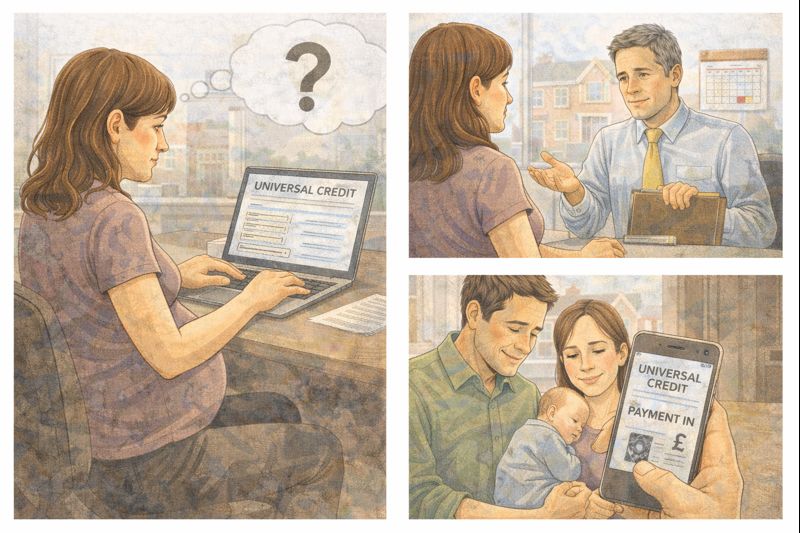
Applying for Universal Credit for the first time can feel confusing, especially when it happens suddenly because of illness. For pregnant women dealing with severe sickness like hyperemesis, the stress is often doubled. Income drops, work becomes uncertain, and decisions have to be made quickly, all while trying to protect your health and your baby.
That is exactly the situation one woman found herself in this week.
She explained that she applied for Universal Credit after being signed off work with hyperemesis during pregnancy. Her employer confirmed that she had already moved onto reduced pay and would soon be on no pay at all. Although her sick note runs out soon and she may return to work briefly, she knows there will likely be more time off due to pregnancy-related illness.
After submitting her Universal Credit claim, she completed all the tasks in her to-do list, including accepting commitments and proving her identity. Her account now says that her first statement will be ready in February and that a payment will be made then, unless she chooses to take an advance.
This left her with a lot of questions. Does this mean she has been accepted for Universal Credit? How does she prove she is on it if she needs things like a free eye test or wants to apply for a Healthy Start card? Does she need to wait for a letter, a certificate, or her first payment before it counts?
These are very common questions for first-time claimants, and the system does not always explain things clearly.
In simple terms, once you have submitted your claim, completed your identity checks, and accepted your commitments, your Universal Credit claim is live. You do not need to wait for your first payment to be “accepted”. The fact that your statement date and payment date are showing means your claim is active and moving through the normal process.
Universal Credit works in monthly assessment periods. The first month is always unpaid until the end, which is why your first payment is scheduled for February. This is normal and happens to everyone. It does not mean your claim is still being decided.
There is also no special certificate that Universal Credit sends out at the start. Proof that you are on Universal Credit usually comes from your online account. For many services, a screenshot of your Universal Credit journal or statement page is enough. Once your first statement is generated, it clearly shows that you are entitled to Universal Credit, even if the payment date is later.
For things like a Healthy Start card, you do not usually need to upload a certificate. The application system checks eligibility electronically using your details. As long as your Universal Credit claim is active, you can apply. The same applies to maternity-related support in most cases.
For eye tests, dental care, or prescriptions, Universal Credit entitlement is usually based on income. Once your first statement is available, that document can be used as proof if needed. Some services may ask to see your statement rather than confirmation of payment.
It is also important to know that Universal Credit can adjust month to month. If you return to work and then have more sickness absence later in pregnancy, your earnings can be reported each month and your Universal Credit will change to reflect that. You do not need to reapply every time your hours or pay change.
If anything is unclear, the best place to ask is your Universal Credit journal. Writing a simple message asking whether your claim is active and how to provide proof for other services is completely normal, especially for first-time claimants.
The biggest reassurance here is this: you do not need to wait for your first payment to be considered “on Universal Credit”. If your claim is live and your statement date is set, you are already in the system.
For someone dealing with hyperemesis and pregnancy uncertainty, the system can feel overwhelming. But in this case, everything described sounds like the claim is progressing exactly as it should.





Leave a comment