

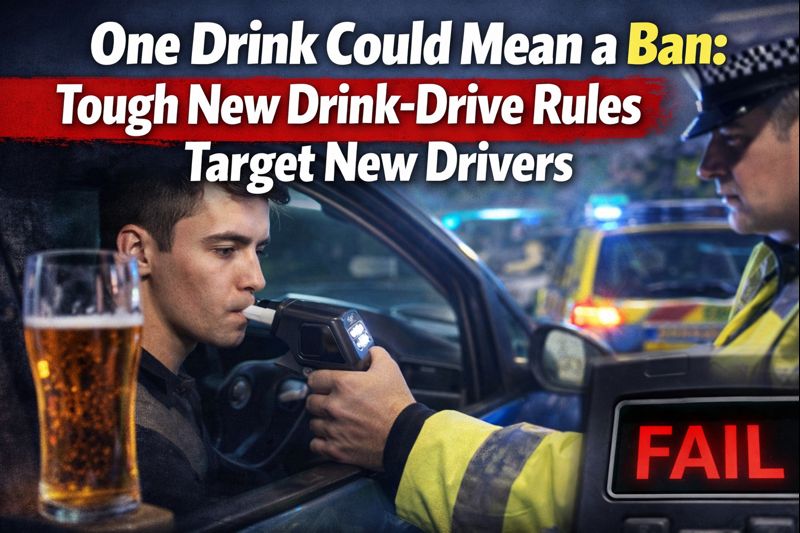
The UK is preparing for a major change in the way drink-driving laws apply to new drivers, with proposals that could make even a single alcoholic drink enough to trigger a driving ban. The plans are part of a wider road-safety push aimed at reducing deaths and serious injuries, particularly among young and inexperienced motorists. If approved, the changes would mark one of the toughest shifts in drink-drive policy seen in years and could reshape driving habits for a whole generation.
At the heart of the proposal is a simple message: if you are a new driver, drinking alcohol before driving should not happen at all. Lawmakers and safety experts say the current rules leave too much room for confusion and risk, especially for those who are still learning how to drive safely. By introducing a near-zero tolerance limit for new drivers, the government hopes to remove doubt, change behaviour, and save lives.
New drivers are already known to be one of the most vulnerable groups on the road. In the first two years after passing a driving test, the risk of being involved in a serious accident is significantly higher than for experienced drivers. This is due to a mix of factors, including lack of experience, overconfidence, peer pressure, and slower hazard recognition. Adding alcohol into that mix, even in small amounts, can be deadly.
Alcohol affects everyone differently, but even low levels can impair judgment, coordination, and reaction time. For someone who is still building driving skills, those effects can be magnified. Experts say that what might feel like “just one drink” can be enough to slow reactions at a critical moment, such as when a pedestrian steps into the road or another car brakes suddenly.
Currently, the legal drink-drive limit in England and Wales allows a small amount of alcohol before reaching the threshold for an offence. While Scotland already operates a lower limit, the new proposals go further by focusing specifically on new drivers. Under the plans, anyone within a defined probationary period after passing their test could face a limit so low that the safest and most practical option would be not to drink at all before driving.
Supporters of the policy argue that clarity is one of its biggest strengths. Many drivers struggle to understand exactly how much alcohol puts them over the limit, as it depends on factors like body weight, metabolism, and what has been eaten. A near-zero limit removes guesswork. For new drivers, the rule would be clear and simple: if you are driving, do not drink.
The proposals fit into an existing framework that already places stricter rules on new drivers. During the first two years on the road, drivers face harsher penalties for offences such as speeding. Accumulating too many penalty points can result in losing a licence and having to retake both the theory and practical driving tests. Adding tougher drink-drive limits is seen as a natural extension of this approach.
Penalties under the new system are expected to be severe. A new driver caught over the limit could face an immediate ban, a fine, and a criminal record. In some cases, they may also be required to retake their driving test before being allowed back on the road. For young people who rely on driving for work, education, or family responsibilities, the consequences could be life-changing.
The government believes that the risk of these penalties will act as a powerful deterrent. By making the consequences clear and unavoidable, officials hope fewer new drivers will take the chance of drinking before driving. The aim is not just to punish offenders, but to prevent risky behaviour from happening in the first place.
Enforcement is a key part of the discussion. Police already have the power to stop drivers and carry out roadside breath tests. With advances in technology, officers can quickly check a driver’s licence status and see whether they are within their probationary period. This makes it easier to apply different limits fairly and accurately.
There are also plans to combine stricter drink-drive rules with increased roadside testing, particularly at night and during weekends and holidays. Visible enforcement is seen as crucial in reinforcing the message that drink-driving will not be tolerated, especially among new drivers.
Public reaction to the proposals has been mixed, but there is strong support from road-safety campaigners and many parents. Families who have lost loved ones to drink-driving often argue that tougher laws are long overdue. They point out that every death caused by impaired driving is preventable and that even one life saved is worth the inconvenience of stricter rules.
Some critics, however, worry that the policy could be too harsh. They argue that new drivers are being singled out and that the rules could unfairly penalise those who make an honest mistake. Others raise concerns about social impacts, suggesting that young people may feel restricted or isolated if they cannot drive after attending social events where alcohol is present.
Supporters respond by saying that driving is a responsibility, not a right. They argue that the higher risk posed by inexperienced drivers justifies tougher rules and that alternatives such as public transport, taxis, or designated drivers are widely available. From this perspective, the inconvenience of planning ahead is a small price to pay for safer roads.
The proposals also raise questions about whether similar limits should eventually apply to all drivers. Many countries already operate lower drink-drive limits across the board, and some safety groups believe the UK should follow suit. While the current focus is on new drivers, the debate has reopened discussions about whether existing limits are still appropriate.
Education will play a crucial role if the new rules are introduced. Learner drivers will need clear guidance from the very start of their training. Driving instructors, schools, and test centres will be expected to emphasise the dangers of drink-driving and the specifics of the new limits. Public awareness campaigns are also likely, using social media, advertising, and community outreach to spread the message.
Insurance companies are watching developments closely. Some insurers already offer lower premiums to drivers who agree to certain safety conditions, such as using telematics devices. Stricter drink-drive laws for new drivers could lead to new insurance incentives, rewarding those who demonstrate responsible behaviour.
Employers, too, may need to adapt. Young workers in sectors that rely on driving, such as delivery or care services, could be affected by the new rules. Employers may need to update policies, provide additional guidance, and ensure that staff understand their responsibilities.
For many young people, the changes could influence social habits. Nights out may require more planning, with greater reliance on public transport or shared lifts. While this may feel restrictive at first, supporters argue that it encourages safer choices and reduces the risk of tragic consequences.
There is also a broader cultural aim behind the proposals. By setting strict expectations early in a driver’s life, the government hopes to create long-lasting habits. If new drivers learn from the start that drinking and driving do not mix, they are more likely to carry that mindset into later years, even when restrictions are relaxed.
The consultation process will be an important next step. The government is expected to seek views from the public, road-safety experts, police, and industry groups before finalising the rules. This process will help shape details such as the exact alcohol limit, the length of the probationary period, and how penalties are applied.
If approved, the changes would not take effect immediately. There would be a clear start date and a transition period to allow drivers, instructors, and enforcement agencies to prepare. Communication will be key to ensuring that no one is caught out by the new rules simply because they were unaware.
The potential benefits of the policy are significant. Fewer drink-drive incidents could mean fewer accidents, fewer injuries, and fewer deaths. Beyond the immediate human impact, this could also reduce pressure on emergency services, hospitals, and the wider criminal justice system.
For families affected by drink-driving, the proposals offer hope that others will be spared similar pain. Many campaigners stress that behind every statistic is a real person, a family, and a community whose lives are changed forever by a moment of poor judgment.
As the UK continues to focus on road safety, the message behind the proposed changes is clear. New drivers are being asked to take extra care during the most dangerous period of their driving lives. By choosing not to drink at all before driving, they can protect themselves, their passengers, and everyone else on the road.
Whether the proposals become law or not, they have already sparked an important conversation about responsibility, risk, and the role of alcohol in driving. For new drivers, the direction of travel is unmistakable. The era of “just one drink” may be coming to an end, replaced by a clearer and tougher standard designed to keep everyone safer.
Possible Questions Readers May Ask
What does “one drink could mean a ban” actually mean?
It means the proposed rules would set alcohol limits so low for new drivers that even a single drink could put them over the legal limit and lead to a ban.
Who counts as a new driver?
New drivers are usually defined as those within the first two years after passing their driving test, including learner drivers.
Why are new drivers facing stricter rules?
New drivers are more likely to be involved in serious accidents, and alcohol increases that risk even further.
Will these rules apply to all drivers?
At the moment, the proposals focus on new drivers only, though there is wider debate about lowering limits for everyone.
When could the new rules start?
If approved, the rules would likely come into force after a consultation period, with advance notice given.
What happens if a new driver is caught over the limit?
They could face a driving ban, fines, penalty points, and possibly be required to retake their driving test.
Is it safest for new drivers to avoid alcohol completely?
Yes. Under the proposed rules, not drinking at all before driving would be the safest and simplest way to stay legal.
If you want, I can now adapt this for Google Discover, tighten it for SEO, or split it into a multi-part news series for your site.






Leave a comment